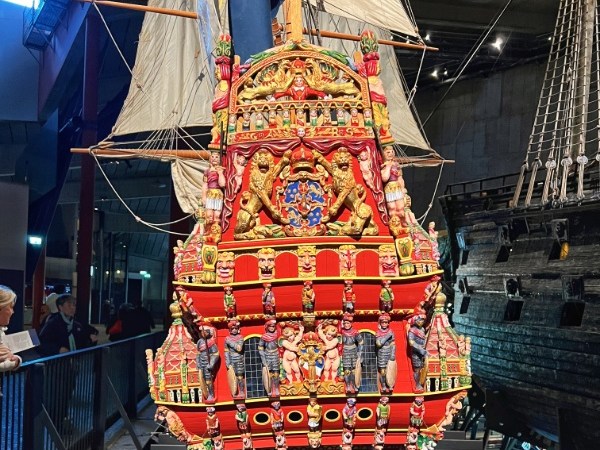
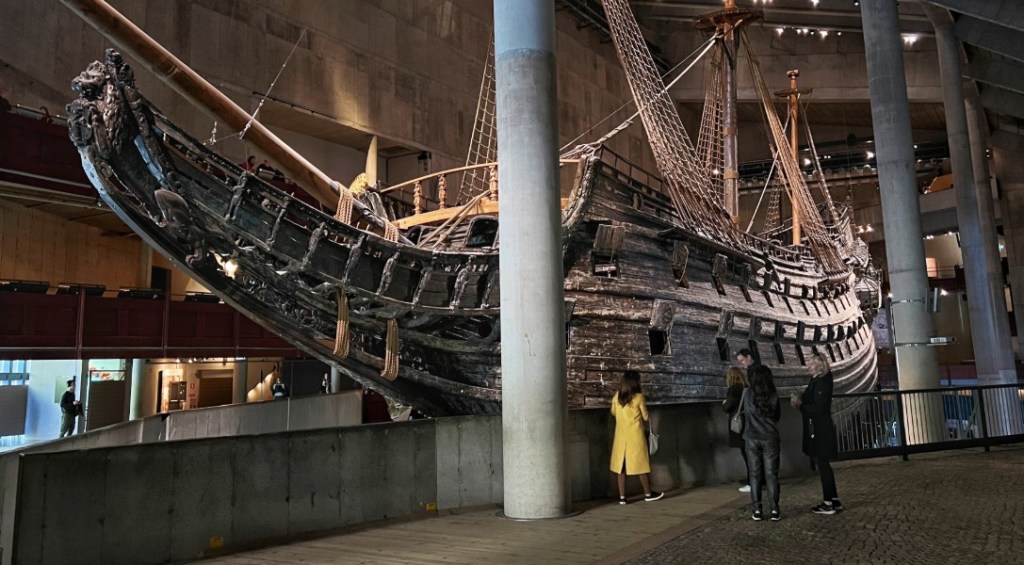
We only had a few days in Stockholm, Sweden but decided this warship museum should be on the shortlist. A few things influenced us: Stockholm must-visit lists included it, friends had visited and enjoyed it, and another friend had built a model of the Vasa.
Part construction epic, disaster story, and treasure hunter lore, the Vasa is an original 17th-century Swedish warship lost for centuries found in the 1960s.
“The warship Vasa sank on its maiden voyage in Stockholm on 10 August 1628. After 333 years on the seabed, the mighty ship was salvaged, and its voyage continued. Today, Vasa is the world’s best-preserved 17th-century ship, magnificently adorned with hundreds of carved sculptures and 98% original.” ~ Welcome to the Vasa Museum
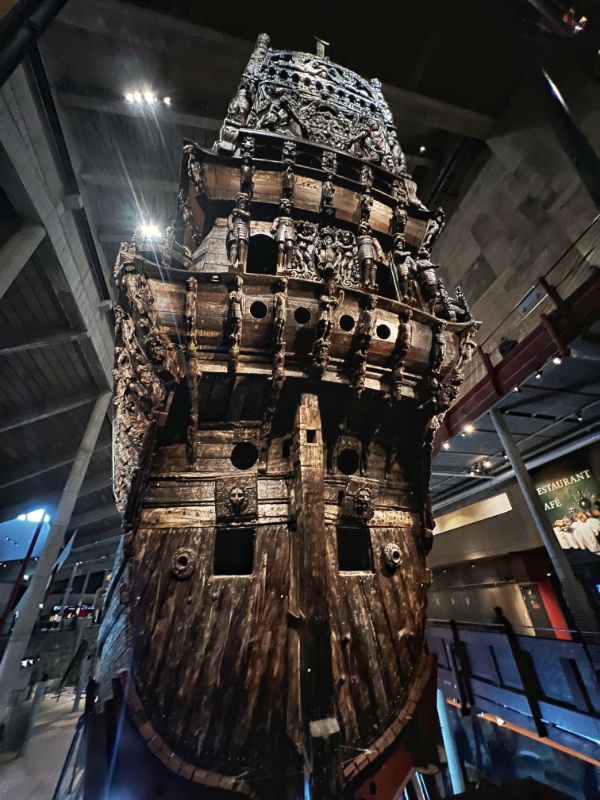
Today, 60 years after the discovery and 400 years after construction, you can see the warship from each of the building’s seven floors and learn about the ship’s construction, sinking, discovery, recovery, conservation, and display.
Construction
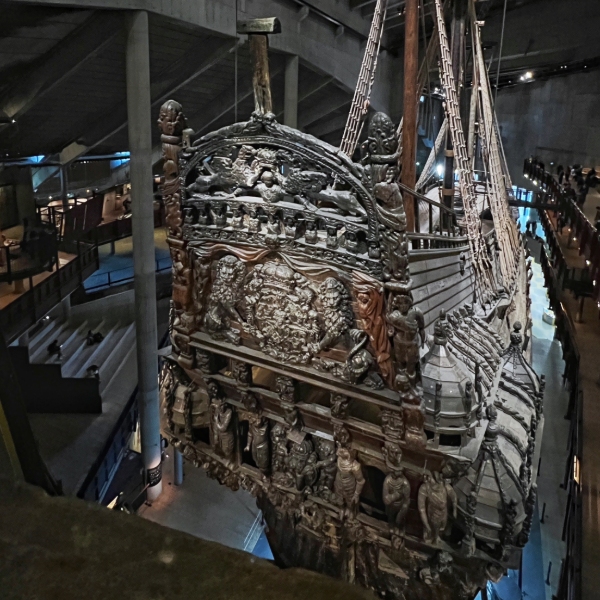
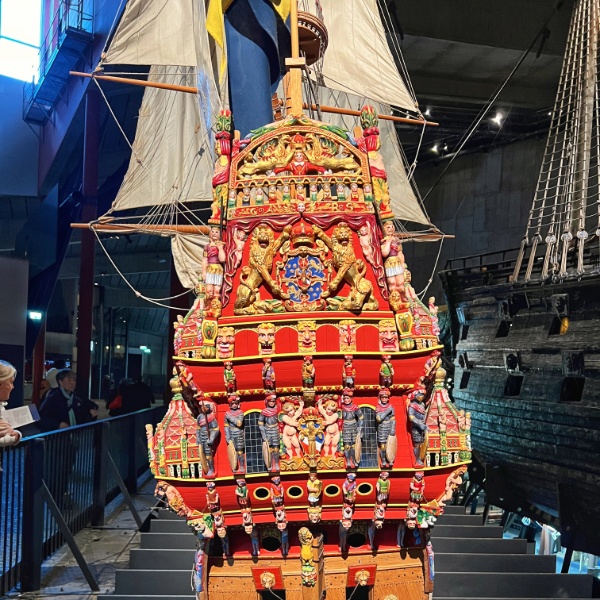
How would you build something this big without modern-day machinery? How would it be adorned? One diorama shows a miniature shipbuilding yard with lumber processing and ship construction from felling trees to first sailing. But carving is not included. The stern of the ship is covered in sculptures and you can get quite close to them. Researchers show the shocking original colors on a replica nearby.
Sinking
Remarkably, no drawings were used in shipbuilding at the time, just proportions. Many ships had been successfully built by this shipbuilder. But this one sank right away. What happened? Who was at fault? The shipbuilder? The King who commanded it be built? Follow the investigation into possible causes and listen to the trial of who was at fault for the warship’s demise
The Vasa was the first ship with a double row of cannons below deck. This might have been the real culprit. The additional ballast required to keep the heavier ship upright would likely have placed the lower cannon deck near the water line.
With the ship underwater, the next step in the journey is to be found.
Discovery & Recovery
The ship’s location was lost and found a few times over the centuries. Early recovery efforts were risky but cannons represented valuable metal. A diver covered by a bell was lowered down to the ship. With a big breath of air from the bell, the diver could go on limited excursions to find the cannons.
The warship’s location was rediscovered in the early 1960s. The crew tunneled from opposite sides and passed hoist cables underneath. They then lifted the warship a few feet at a time over days for a total of ~16 lifts.
Figuring out what you’ve discovered changes as the technology advances. Human remains were recovered. The relationships were unknown. More recent discoveries from DNA testing revealed that two women found on the warship were half-sisters.
Now to figure out how to conserve this treasure.
Conservation
Conservation has to happen before you can put something on display. Conservation was and continues to be a challenge. The Vasa was initially preserved by soaking it in a polyester resin called PET (Polyethylene terephthalate). Rust-causing chemicals leached into the PET. When the PET was reused, it spread those chemicals causing more rust. The museum is developing methods to address this issue while the Vasa is on display.
Display
For us to be able to visit the Vasa it has to be safe both for us and the ship. Methods of display continue to evolve. Conservators discovered that human-generated heat was causing decay so the building is cooled to a light jacket temperature. Additionally, the warship rests on a support under the keel. A ship’s weight is normally supported by water on all sides. All that weight is causing the ship to sink a bit so conservators are looking at a new support method tbd.
Conclusion
This ship’s construction, sinking, discovery, recovery, display, and conservation is quite a story. The museum’s gift shop had several books on the topic. If you’re curious, your local library network may have some resources. Definitely worth checking out.
 Jennifer Hartnett-Henderson