
Recently, I’ve been sick and used the time to read and enjoy some books. Fortunately, I could do that.
Book Marks: An Artist’s Card Catalog
The first was Book Marks: An Artist’s Card Catalog, Notes from the Library of my Mind by Barbara Page published in 2021.
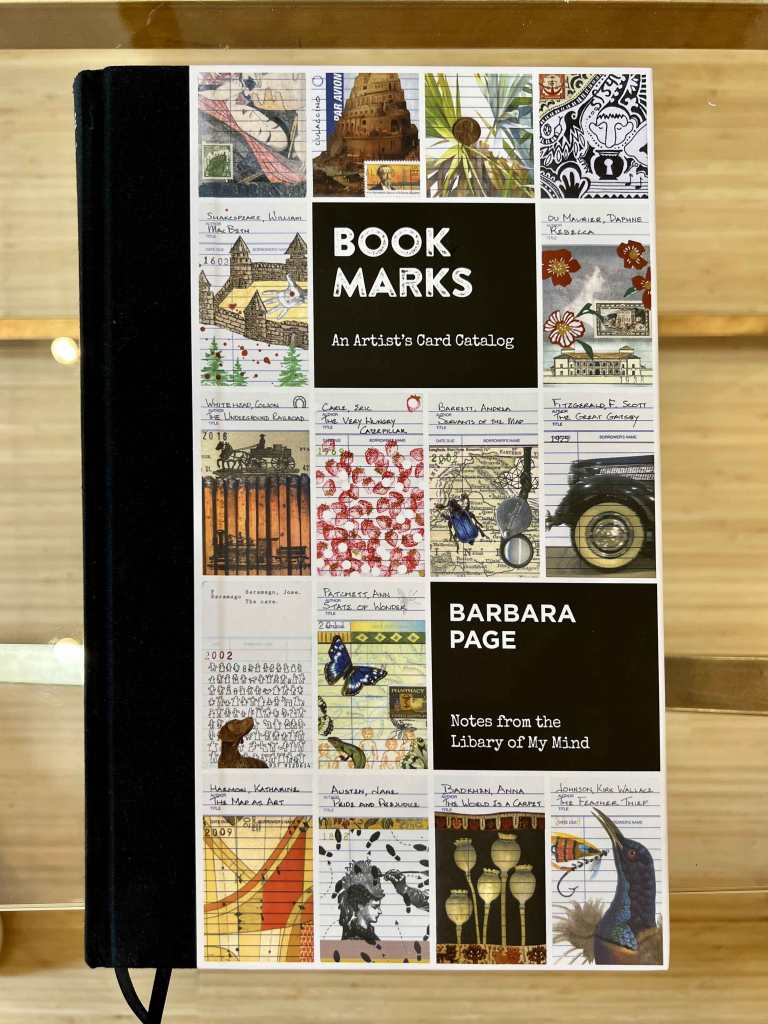
Book Marks’ six chapters contain Page’s biography of seven decades interleaved with the books that influenced her during each period. The essay is followed by illustrated library checkout cards for the books that marked her life during that time. Each library checkout card includes the author’s name, the book title, the year that Page read it, and Page’s personal illustration of her memories and marks that the book made on her.
Pages’ catalog helps her memory of what books she read and their influence on her take root. Page uses her childhood stamp collection, rubber stamps, drawings, cut-out images, maps, and more to codify her memories. It’s fascinating to look at each book checkout card and see what’s on it as well as compare that to your own memories of the book. She stores the cards in a wooden two-drawer library case arranged by the year she read them.
Her biography covers tough stages of her life such as others’ mental health, being a single mom, and caring for a loved one with dementia. Her work gives physical heft to how books impact our lives and it inspired me to read more. At first, I thought I should read books that influenced her but gradually I realized I should just read what I wanted to read.
At 70+ years old, Page’s catalog of life and books is an ambitious overview of events and influences. This book is a brilliant piece of coding and externalizing memory. While I would have expected to find this in the biography section, I found it in the Pearl Room, Art, at Powell’s.
Where the Hornbeam Grows
I found Where the Hornbeam Grows: A Journey in Search of a Garden (2019) in the Garden Writing section at Powell’s.

While Book Marks is at least half visual, this book is all text. The book opens with the loss of the author’s mother, an avid gardener with an exuberant garden and an always-ready plant wish list. Not long afterward, Lynch and her Canadian husband moved unexpectedly to Switzerland.
Lynch lives through the question of what makes a home when your parents are gone and your own house is sold? The Swiss were not entirely welcoming according to Lynch. After two years in Zurich with no garden and little social connection, the pair moved to a house with a garden in a slightly more welcoming smaller town. Both Lynch and her husband worked hard on and struggled with how to take root in Switzerland. Although they cultivated a rich garden there over 5 years, ultimately the cultural exclusion proved unacceptable. The couple decided to return to England.
Lynch meditates on what it means to be a foreigner or someone of the forest, and whether being from the forest is bad in gardening terms. She’s comforted by finding wild forests in gardens and gardens in the wild forests, domestic plants in the wild, and wild plants in the garden.
Lynch is British and completed a doctorate in seventeenth-century literature. In Where the Hornbeam Grows, she often refers to British author John Milton’s Paradise Lost (1674), an epic poem of 12 books and over 10,000 lines about the fall of Adam and Eve in the Garden of Eden. A wooded hill is “where Milton locates the ‘enclosure green’ of paradise. Enclosure green: a garden of the woods.” As a foreigner, of the forest to the Swiss, Lynch works on how to take root, how to make a garden of the woods. She took root by making a garden in the forest of foreignness but it was in the end not enough to call Switzerland home.
Thank you
Writing, publishing, and promoting a book takes time, commitment, a supportive community, and lots of interior work and external review. I am grateful for these and other contemporary women who have chosen to share their life stories through the written word.
 Jennifer Hartnett-Henderson